
The Colombian Energy and Gas Regulatory Commission (CREG) issued Resolution CREG 101 120 of 2026, establishing a temporary program of incentives for the efficient use of electricity by regulated users in Colombia’s National Interconnected System (SIN). The program was subsequently amended by Resolution CREG 101 126 of 2026, primarily with respect to its start date and its application to users located in municipalities affected by the August 10, 2026 earthquake.
Against this backdrop, the program is intended to temporarily reduce electricity demand during periods of tight energy supply, low hydrology or risks to system reliability. It does so through two economic signals: an additional charge for users whose consumption increases significantly relative to their historical consumption, and a financial benefit for users who reduce it.
In addition, the mechanism is temporary, automatic and self-funded. Users are not required to enroll, and the program does not modify the general electricity tariff formulas. Benefits are funded with the additional charges actually collected under the program.
Who Is Covered?
The program applies automatically to regulated users served by retail electricity suppliers in the SIN whose billing cycle is no longer than two months.
However, certain users are excluded, including users whose consumption is determined by methods other than meter readings, users with prepaid meters or suspended service, healthcare institutions, educational establishments, care facilities, emergency response organizations, security institutions and correctional facilities, as well as government users and small-scale self-generators (AGPE, for its Spanish acronym) that use energy credits.
In addition, users may request exclusion if they can demonstrate a medical condition requiring the permanent or intensive use of electrical equipment essential to preserving life or health.
Additionally, Resolution CREG 101 126 introduced a territorial exclusion: the program does not apply to regulated users located in municipalities officially identified by the National Unit for Disaster Risk Management (UNGRD) as affected by the August 10, 2026 earthquake.
Each User Has an Individual Consumption Target
Each user is assigned an individual daily consumption target, generally calculated as the median of the user’s average daily consumption during the twelve months preceding the effective date of Resolution CREG 101 120.
Where sufficient historical information is unavailable, a reference target is assigned based on comparable users. The individual target may not be lower than the applicable subsistence consumption threshold and, once established, remains unchanged throughout the program.
The rules also prevent a new account holder from inheriting the consumption pattern of the previous one: when the account holder changes, the new holder is assigned the applicable reference target and begins with no accumulated recognized savings.
What Happens Depending on Consumption?
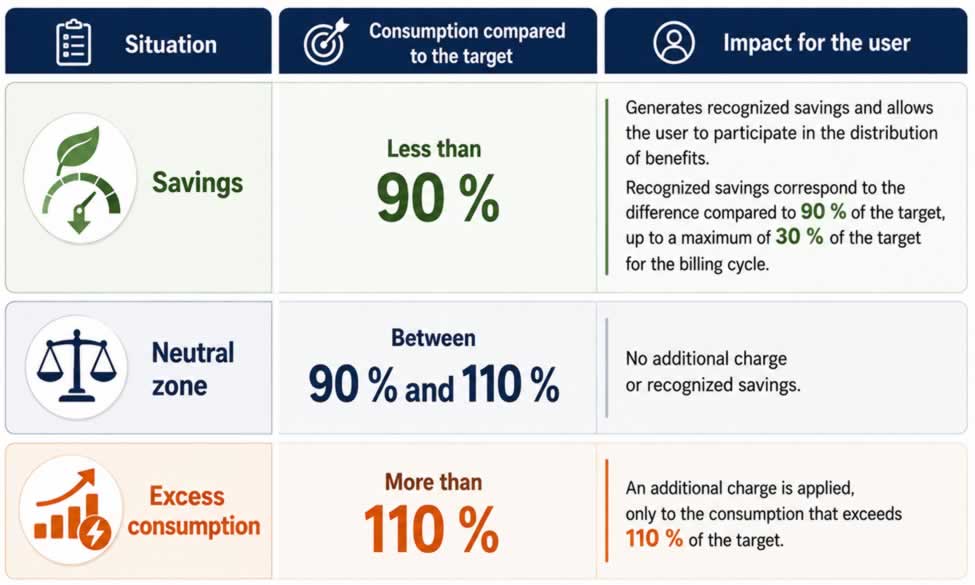
For consumption above 110% of the target, the applicable charge factor is 1.30 for residential users in strata 1 to 3; 1.50 for residential users in strata 4 to 6; and 1.70 for regulated commercial and industrial users.
In practical terms, this results in an additional charge equal to 30%, 50% or 70% of the applicable regulated reference tariff, depending on the type of user, applied only to the kilowatt-hours consumed above the 110% threshold. The additional charge per kWh of excess consumption may not exceed the applicable Incremental Operating Cost of Rationing for residential stratum 4 (CRO, for its Spanish acronym).
For example, if a user’s target for a billing cycle is 200 kWh, consumption between 180 and 220 kWh generates neither an additional charge nor a benefit. If the user consumes 250 kWh, the additional charge applies only to 30 kWh; if consumption falls to 160 kWh, 20 kWh are recognized as savings.
How Are the Incentives Funded?
Each retail electricity supplier establishes a fund for each commercialization market consisting of the additional charges actually collected, together with any late-payment interest and returns earned on those amounts.
In other words, users who consume above the threshold fund the benefits paid to users who save energy within the same commercialization market. Funds may not be transferred between markets.
Subsequently, at the end of each settlement period, the available funds are distributed among users with recognized savings who meet the eligibility requirements, in proportion to their recognized savings index—that is, their savings relative to their accumulated consumption target. The benefit is credited to the user’s electricity bill.
Accordingly, saving energy does not guarantee a predetermined monetary benefit. The amount depends on the funds actually collected in each market: if collections are low, the amount available for distribution will also be low; if no funds are collected, there will be no financial benefit to distribute.
In addition, saving energy is not sufficient, by itself, to qualify for a benefit. Among other conditions, the user must not be in arrears at the time of settlement and must not have engaged in fraud or meter tampering that has been technically substantiated during the program.
When Does the Program Start?
Initially, Resolution CREG 101 120 established August 15, 2026 as the program’s start date. Resolution CREG 101 126 amended this rule: the program will begin on the fifth business day counted from the day following publication of Resolution CREG 101 126 in the Official Gazette and will initially remain in effect for six months.
Once the program begins, the first meter-reading cycle for each user ending on or after the program start date will be treated as an educational cycle. The retail electricity supplier will inform the user of the additional charge that would otherwise have applied, but the charge will not actually be collected. Any savings achieved during that cycle will, however, be recognized, and additional charges will begin to accrue from the following cycle.
Retail electricity suppliers must also inform users about how the program operates and provide information on their consumption target, actual consumption, recognized savings and any applicable additional charge. Failure to pay the additional charge may not result in suspension of electricity service, without prejudice to its collection in accordance with the rules established in the Resolution.
Key Strengths and Areas of Debate
A Simpler Mechanism Than Originally Proposed
The draft regulation submitted for public consultation contemplated several tiers of excess consumption with different charge factors, as well as a competitive mechanism among energy savers to determine which users would receive the incentive.
In response, the final regulation significantly simplified the mechanism: it adopted a single charge factor for each category of user and provides for the proportional distribution of available funds among all eligible savers. These changes make the program both easier for users to understand and simpler for retail electricity suppliers to implement.
Self-Funding: A Strength That Also Creates Uncertainty
The program does not require government funding or create an additional tariff-based source of revenue to finance the incentives. Instead, users who consume above the threshold provide the funds distributed to those who reduce their consumption.
That same feature, however, makes the monetary value of the incentive uncertain. A user may make a significant effort to reduce consumption and still receive only a small benefit—or no benefit at all—if collections in that market are limited.
Therefore, for the program to induce a change in consumer behavior, the incentive must not only exist but also be sufficiently clear and economically meaningful to users.
A Uniform Rule Applied to Very Different Consumption Patterns
During the consultation process, stakeholders raised concerns regarding commercial and industrial users with seasonal consumption patterns, recent changes in the use of a property, new electricity consumption associated with electric mobility, and other circumstances in which an increase over historical consumption does not necessarily reflect inefficient energy use.
In response to these concerns, CREG chose to retain a broadly applicable methodology based on the twelve-month median, a 10% neutral band, a cap on the additional charge and certain exclusions, rather than introducing individual adjustments.
As a result, this approach provides simplicity and objectivity, although a historical baseline may not fully reflect all changes in a user’s specific consumption circumstances that may arise during the six-month program.
Non-Regulated Users Are Not Included
Another issue raised during the consultation was the exclusion of non-regulated users, which account for a significant share of electricity demand and, in many cases, have greater technical capacity to manage their consumption.
Nevertheless, CREG maintained the program’s focus on regulated demand, noting that non-regulated users operate under different contractual arrangements and have access to other demand-response mechanisms in the wholesale electricity market.
As a result, this avoids overlap between different regulatory mechanisms, but it also limits the portion of total electricity demand directly exposed to the program’s savings incentive.
The Implementation Challenge
Retail electricity suppliers also raised concerns regarding the costs and system developments required to calculate individual targets, modify billing systems, administer the program funds, submit regulatory reports, communicate with users and handle complaints.
In response to these concerns, CREG simplified several elements of the original proposal but maintained that implementation does not entitle retail electricity suppliers to additional remuneration or allow them to pass implementation costs on to users. Actual implementation will show whether those simplifications are sufficient to address the program’s operational requirements.
A Mechanism Colombia Has Used Before
The program has a relevant precedent in “Apagar Paga”, a mechanism adopted by CREG during the 2015–2016 El Niño event, which also used economic signals to encourage reductions in electricity consumption.
However, the 2026 program has a different design. Its effectiveness will ultimately depend on whether users understand the signal, whether the economic incentive is sufficiently meaningful, and whether the resulting reduction in consumption is large enough to help ease periods of system-wide supply tightness.